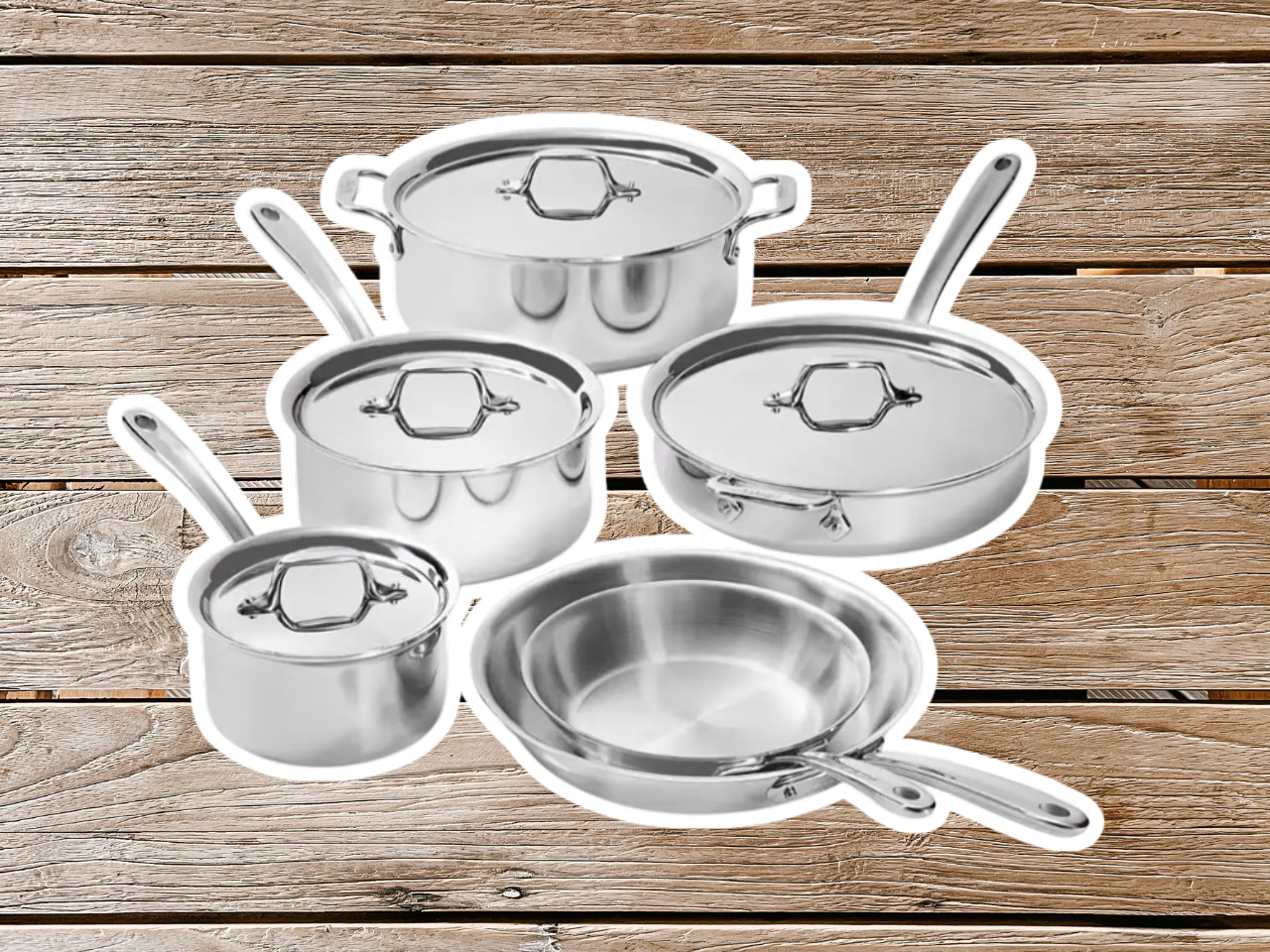
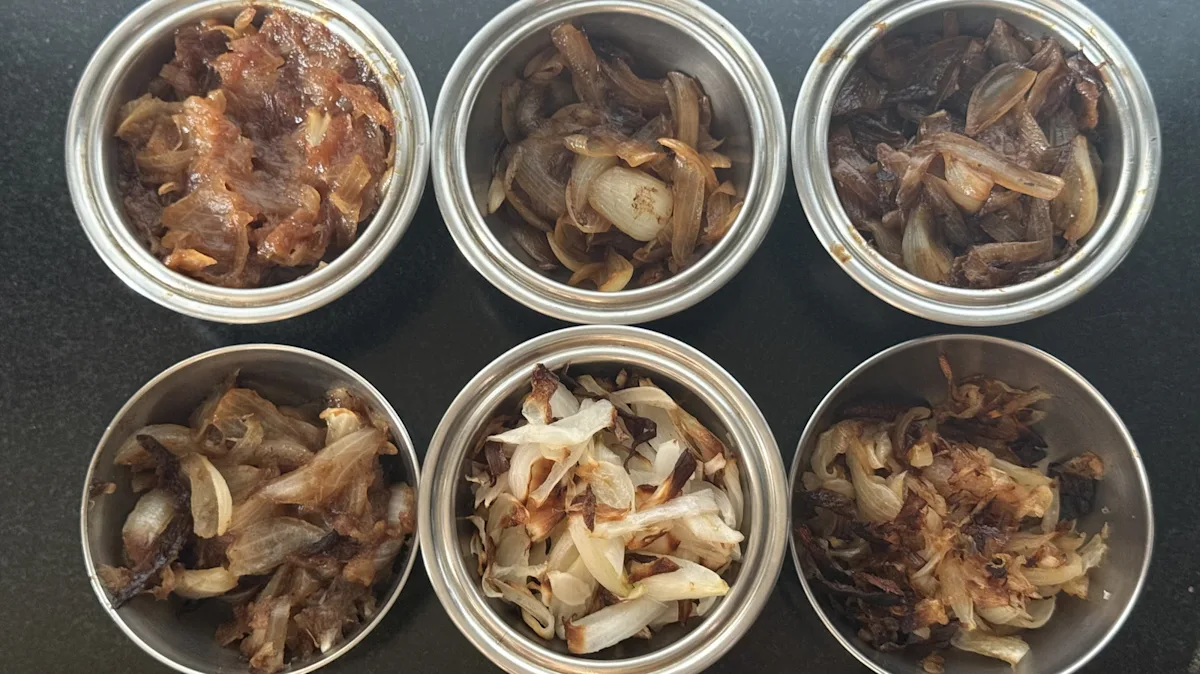

Six stainless steel bowls of caramelized onions cooked using different methods – Sierra Winters / Tasting Table
My husband and I drop more money than we’d like to admit on bowls of French onion soup at our favorite French restaurant. But how could we resist the explosion of flavor granted by broth, bread, cheese, and caramelized onions? Sweet, salty, and herbaceous, this dish showed me how caramelized onions can shine outside of burgers and pizzas. I wanted to perfect my homemade French onion soup (and add more pizzazz to sandwiches and quiches), so I set out to ascertain the best way of caramelizing onions.
In this review, I’ll provide instructions on how to use the stovetop, oven, Instant Pot, and air fryer to prepare caramelized onions in six different ways, using nothing more than butter, salt, onions, and sometimes vegetable broth. Although you can achieve shockingly good caramelized onions with a variety of ingredients like brown sugar, alcohol, and balsamic vinegar, I kept things simple so that I could better evaluate the flavor and texture of the onions themselves. I’ll share my feedback on each method, noting the pros and cons of the cooking process and the resulting onions. Finally, I’ll reveal my preferred technique at the very end.
The two most important ingredients required to cook traditional caramelized onions are patience and time. While I’ve chosen my favorite method based on the final flavor and texture of the onions, you might rather opt for a quicker method. There’s absolutely no shame in using B+ caramelized onions rather than A+ caramelized onions if that’s what works for your lifestyle.
Read more: 17 Tips For The Fluffiest Scrambled Eggs
Classic stovetop

Stainless steel bowl of caramelized onions cooked on stovetop – Sierra Winters / Tasting Table
Caramelizing onions on the stovetop is the most well-known method that exists. That’s why I tested this technique first; having used it before, there was no learning curve for me to tackle. I turned my gas stove on to its lowest setting, then added a dab of butter. Once it had melted, I poured in the sliced onions and sprinkled them with a touch of salt. Every so often, I stirred the pan to make sure the onions didn’t burn.
Because my stove doesn’t do anything halfheartedly, even on the lowest flame, I needed to deglaze the pan periodically with splashes of water. However, H2O is not the only liquid that you can use for this purpose; this foolproof caramelized onions recipe, for instance, suggests capitalizing on the umami flavors of vegetable broth. Meanwhile, foodie TikToker Jeremy Scheck recommends adding water or wine from the outset to prevent scorching and amp up the flavor.
It took me about 35 minutes to caramelize my onions using this method, though cooking time will vary depending on your stove and how hot the burner is. I found the resulting caramelized onions to be sweet, yet there was also a persisting astringent flavor present that provided complexity. The onions had just the right amount of chew, and each slice was distinguishable from the one next to it. There’s a reason why this method is so beloved by top chefs around the world; it’s basic, it’s reliable, and it yields great results.
Braised

Stainless steel bowl of braised caramelized onions – Sierra Winters / Tasting Table
I was excited to try braising my onions because I recently found out that doing so was the best way to cook Brussels sprouts. Braising is a process in which a food item (typically a meat or vegetable) is sautéed, then simmered in a liquid like broth, wine, or beer until tender and juicy.
Braising onions offered me the best of both worlds. Simply sautéeing onions can often result in them being a touch too dry, while some of the other methods I tested elicited a soggy texture. I achieved sweet, juicy onions by first caramelizing my onions in a pan with butter and salt, then letting them soak up the flavor and moisture of vegetable broth. I didn’t need much vegetable broth to follow this technique — only enough to cover the bottom of the pan. This liquid was absorbed and evaporated in just under 10 minutes.
These onions were incredibly flavorful and moist, and they weren’t at all mushy. They contained the perfect balance of sweet and astringent, and they possessed enough texture to be used in dishes of all kinds, including sandwiches, quiches, dips, and pizzas.
Stovetop with baking soda

Stainless steel bowl of caramelized onions cooked on stovetop with baking soda – Sierra Winters / Tasting Table
Before I said goodbye to my gas stove, I had one last method to try: a simple sauté sped along by baking soda. Though you might use this powdery white ingredient more often in muffins and pancakes, baking soda can also alter the pH of caramelized onions. The scientific reason is that it boosts the Maillard Reaction and caramelization processes, both of which take place after the sugars in onions have been set free. Therefore, the amount of time needed for onions to turn that lovely shade of caramel brown reduces.
I added butter, salt, ⅛ teaspoon of baking soda, along with 1 pound of sliced onions, to the pan. I then sautéed as usual, but was pleased to find that the amount of time I needed to stand at the stove was shortened. The onions began to brown within the first five minutes and were fully finished within 15 minutes. However, I noticed that the onions, while still somewhat chewy, were also noticeably mushy. Because they were so moist, I would use these caramelized onions in soups and stews rather than tarts and pizzas.
As for flavor, the baking soda had a minor, yet noticeable effect: It made the onions sweeter. This could be what you’re looking for in certain dishes — perhaps to balance out spiciness — but I personally missed the onions’ natural pungency. Finally, I appreciated the lovely aroma produced in this method; it was the strongest of all the onions I cooked.
Oven

Stainless steel bowl of baked caramelized onions – Sierra Winters / Tasting Table
When there’s an option to cook a dish in an oven rather than on the stovetop, I usually jump on it immediately. In my household, burners are always in high demand, so being able to pop food into the oven and leave the kitchen is a huge relief.
For this method, I combined sliced onions, butter, and salt in a bowl, then spread the mixture out on a well-oiled miniature cast-iron pan. All in all, I baked the onions for 45 minutes at 400 degrees F, stirring every 10 minutes. I covered the onions with aluminum foil for the first 20 minutes to create a steamy environment in which they could tenderize. It took 45 minutes for my onions to sufficiently brown, though this timeframe may vary depending on your oven model.
These onions were uneven in texture and flavor. Though I stirred regularly, the onions on the edge of the pan roasted more quickly than those at the center. This produced charred, bitter edges on some of the slices. Using a different pan, a baking sheet, or an oven-safe dish could help circumvent this problem. If you can crack the code, I recommend cooking large batches of caramelized onions in the oven when you are in a time crunch or when you are going to follow a recipe that requires preheating the oven anyways. For instance, you might caramelize your onions using this method, then incorporate them into these cheesy caramelized onion tarts.
Instant Pot

Stainless steel bowl of caramelized onions cooked in Instant Pot – Sierra Winters / Tasting Table
Folks take different sides on whether or not caramelizing onions in an Instant Pot is effective. Some say that the slow cooker function could suffice; after all, slow cookers are known to provide a hands-off method for easy bulk caramelized onions. However, the timings listed for traditional slow cooker recipes may not translate. Others believe that an Instant Pot won’t ever be able to achieve caramelized onions with bite and discernible texture. Manual pressure cookers may yield slightly better results, some believe, because they can operate at a higher maximum pressure (roughly 15 psi as opposed to about 12 to 12.5 psi). I decided to see for myself what an Instant Pot could accomplish.
I added sliced onions, butter, and salt to the pot, then closed the lid and cooked the mixture on high pressure for two minutes. I nearly jumped out of my skin when my Instant Pot blared a warning that the onions were burning. I began again, adding a splash of water to prevent scorching. As soon as the cooking cycle completed, I manually released the pressure before removing the lid. I then sautéed the onions on high, periodically stirring them and adding water to deglaze the pan until they were golden brown. This final step took about 10 minutes.
I was rewarded with caramelized onions that were mushy, but very flavorful and extremely sweet. It was like onion jam, which tastes much better than it sounds. These onions were the perfect candidate for my French onion soup, though I wouldn’t use them in recipes where I want my caramelized onions to stand out for their smoky sweetness and chewy texture.
Air fryer

Stainless steel bowl of caramelized onions cooked in air fryer – Sierra Winters / Tasting Table
An air fryer might be one of the most convenient and versatile appliances in your kitchen. By quickly circulating air in a small space at high heat, an air fryer can simultaneously cook food efficiently and lend it a crispy, crunchy texture. Of course, the settings matter a great deal. Crispiness is not an inherent promise of an air fryer, nor should it be. For instance, the settings you use to bake a cake in an air fryer will not be what you use to caramelize onions.
For this method, I preheated my air fryer to 375 degrees F. While it warmed up, I mixed the onions, butter, and salt in a bowl and then added them to the air fryer basket for 10 minutes. In this method, it’s essential to shake the basket every few minutes to ensure even cooking; I opted to remove, shake, and reinsert the basket every four minutes for safety.
These onions impressed me with their aroma, but that was just about it. Even their sharp scent was indicative of this method’s downfall: Air fryers are more effective at frying onions than caramelizing them. Don’t get me wrong: Fried onions are delicious, but they aren’t what I was going for here. The tips were burnt, and the onions were anything but soft. This was easily my least favorite technique of all that I tested.
The verdict

Onions caramelizing in pan – Sierra Winters / Tasting Table
Braising onions was my favorite method on this list, hands down. Though it wasn’t the quickest technique, it also wasn’t very difficult. Plus, I like the flexibility that braising offers. The type of vegetable broth you choose can make a major difference in the resulting flavor of the caramelized onions. Chicken broth, wine, sherry, bourbon, beer, or a liquid of your own concoction will each work wonderfully. If you want your onions to be juicy, but not mushy, braising them is the ticket.
After all these taste tests, I was left with a bucket of caramelized onions. This wasn’t a problem, though, because as I mentioned earlier, I had French onion soup on my mind. Besides, you can always refrigerate or freeze caramelized onions for several days or longer. I hope you enjoy your caramelized onions as much as I did. You, too, can follow an easy French onion soup recipe to use them all up.
Want more food knowledge? Sign up to our free newsletter where we’re helping thousands of foodies, like you, become culinary masters, one email at a time. You can also add us as a preferred search source on Google.
Read the original article on Tasting Table.