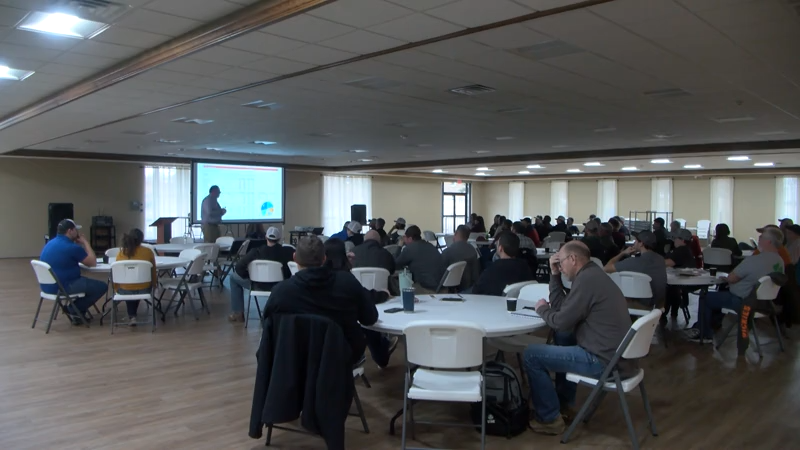

Farmers and agronomists at the Purdue Top Farmer Conference 2026 likely didn’t need reminding about the challenges they face growing corn and soybeans this year. But just to set the stage, Michael Langmeier, director of the Purdue Center for Commercial Agriculture, reminded them anyway.
“Low corn and soybean prices mean crop budgets are tight this year,” he said. “At the same time, input prices are higher, especially for some inputs. That means that in our budgets where we include all costs, we’re looking at negative margins again this year.”
And so, limiting input costs without reducing yield potential is at a premium right now, he added. To shed light on where those opportunities might exist, Dan Quinn, Purdue Extension corn specialist, and Shaun Casteel, Purdue Extension soybean specialist, took center stage. Langemeier opened the floor for questions from farmers and agronomists:
You show yield benefit in many cases for applying AMS for sulfur. You also show similar results for applying gypsum. In no-till, would applying AMS help more, because the nitrogen might help break down residue?
Casteel: We’ve seen very similar results in our trials from AMS or gypsum on early planted soybeans. Sometimes AMS yields may seem a tick better, but I can’t tease out any significant difference. Here’s my bottom line: It depends on the price point. If AMS is cheaper, I would go that way. If gypsum is the better deal by price, apply gypsum.
As for residue concerns, our trials indicate sulfur is probably helping overcome the carbon penalty more than nitrogen for soybeans. So, again, it comes back to price points.
We farm on productive prairie soils, and we’re working toward 300 bushels per acre so budgets pencil out. We apply enough nitrogen, have good soil tests and apply sulfur. Where do we go next to boost yields?
Quinn: We understand where you’re coming from. We have similar soils here at the Purdue Agronomy Research Center, and we’re pushing yields. One of the biggest pieces for me is genetics. We can treat various hybrids exactly the same and see 20- to 30-bushel-per-acre yield differences. Work with your seed reps and try hybrids from different companies. See what works best for you.
Another key piece is likely sulfur, especially where nitrogen rates are higher. Perhaps you need more sulfur as well. Pay attention to interactions between nitrogen and sulfur, and nitrogen and potassium.
My boron levels in corn are often low to very low in tissue tests. Could I likely see a benefit from adding boron?
Quinn: I have not seen a response to boron in corn on productive soils. Bob Nielsen and Jim Camberato [both Purdue Extension specialists] looked at boron here before me and did not see responses either. One issue with some micronutrients and tissue tests is there isn’t a lot of data behind calibrating readings to what they mean in the field.
One thing we’re looking at is the possible benefit of applying boron at tasseling and pollination. There is interest in seeing if adding boron with a fungicide makes a difference. Right now, we do not know.
We don’t have those black, productive soils. Our soils are sandier and lower in organic matter. What should we be thinking as far as inputs?
Quinn: No. 1, you can probably get by with lower seeding rates for corn, reducing seed costs. My work with farmers on these soils indicate they typically do well at seeding rates of 28,000 to 30,000 seeds per acre. In fact, bumping seeding rates too high can reduce yields.
Second, these are the soils where we expect the biggest response to sulfur in corn. If you aren’t already adding sulfur on these soils, you may pick up some bushels there. Finally, consider nitrification inhibitors and stabilizers for nitrogen application. These products work well, but only if there are conditions conducive to N loss. We see those conditions more often on these soils.
Casteel: Any soils with less than 2% organic matter are likely sandy textured, so think sulfur for sure. On these soils, we would suggest applying sulfur in the spring from March through planting when field conditions are fit.
We have 1% organic matter, sandy soils and apply 100 pounds of potash plus 100 pounds of AMS in the spring before soybeans. How early do we need to apply?
Casteel: Now we’re talking about potential chloride toxicity from applying potash if it goes on too close to planting. We’ve applied 100 pounds of 0-0-60 after planting, and we can see a 5- to 7-bushel-per-acre yield hit on sandy soils. Occasionally, we’ve seen a 3- to 5-bushel-per-acre yield hit on heavier ground when we applied 200 pounds of 0-0-60 at planting. If you apply too close to planting. If you need potassium, apply at least a month before planting, especially on sandier ground. Rain dilutes chlorides. Otherwise, you risk burning root hairs, and that impacts nodule development.
If you can’t make the application in time, consider waiting until soybeans get established and then apply it over the top.