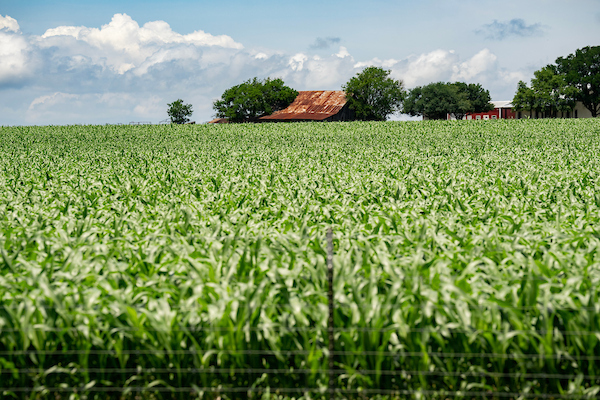

REDWOOD FALLS, Minn. — Yes, Minnesota’s corn crop is uneven and drought-stressed in some areas, but that’s not going to be enough to move the market, according to Mark Schultz, chief market analyst for Northstar Commodity.
He said there’s going to have to be some signs of crop stress in Iowa and Illinois to drive down national yield estimates below 172 bushels per acre to give corn any significant bump. That’s because of lackluster demand, with South America having plenty of supply.
“You are not going to go up in the corn market on demand,” Schultz said. “You’re only going to go up on the corn market if you have a crop that is below expectations.”

Jeff Beach / Agweek
Schultz delivered his comments Tuesday, Aug. 1, on the opening day of Farmfest near Redwood Falls. He was part of a Farm Bureau Ag Outlook panel.
He did say the
in Iowa is worth watching — with 60% to 70% of the crop needing moisture.
He said the growing season is reminiscent of 2022, when dry weather heading into August elicited fears of reduced yields.
Instead, Minnesota got some excellent late summer rains and the state ended up with a record corn yield of 218 bushels per acre.
With the right rains, a good corn crop is still possible.
“The crops have an amazing ability to hang on,” he said.
Dave Nicolai, a University of Minnesota Extension educator, said producers should be looking out for corn rootworms that have been prevalent this year.
“Corn on corn is still problematic,” he said, emphasizing that rotations can mitigate rootworm pressure.
But last year’s problem corn disease, tar spot, is “negligible” this year.
Overall, he said only 36% of the Minnesota has adequate moisture, leading to “extreme variability in crop height.”
The
U.S. Department of Agriculture Crop Progress released July 31
, had 36% of Minnesota corn crop in fair condition; 40% good and 7% excellent.

Jeff Beach / Agweek
For the
“beans at least have demand,” Schultz said, noting some recent export activity to help the market in what looks like a good U.S. crop.
He’s seen a lot of short soybeans in Minnesota but figures if they get rain by Aug. 15-20, they should be decent. Despite being short they have good color.
“They look like they must be healthy,” Schultz said.
USDA Crop Progress had 39% of Minnesota soybean crop in fair condition; 42% good and 6% excellent.
In the futures market, Schultz sees support at $13 per bushel and $16.50 for November beans “can’t be ruled out.”
Nicolai said producers should be on the lookout for soybean aphids and notes that they are highly mobile. “They can be here today and gone tomorrow,” he said.
For wheat, it’s in a similar demand situation as corn. While the Ukraine-Russian war is impactful, they are still exporting.
“Demand is not going to happen until Russia runs out of wheat,” he said.
Nicolai said he expects sugarbeet prepile for Southern Minnesota Sugar Beet Co-op at Renville to start by Aug. 15.
The USDA crop progress report released July 31 had 66% of
in excellent condition.
For Minnesota, “the shining star is the sugarbeet crop,” he said.