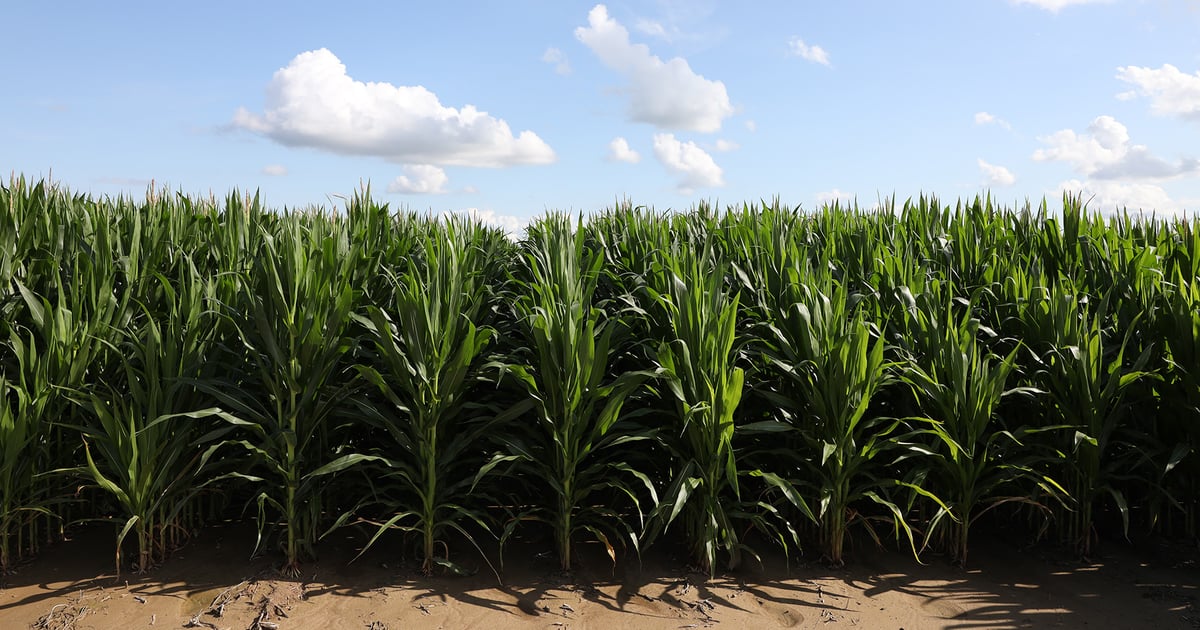
As sulfur increases in popularity as a potential yield booster in high-yield corn environments, researchers are hard-pressed to address why sometimes sulfur applications work and sometimes they don’t.
A collaborative first-year study in 2025 with research trials hosted by Oklahoma State University, University of Arkansas and Mississippi State University set out to discover the costs and benefits of sulfur in corn systems and found mixed results.
“In Oklahoma, corn isn’t really our primary crop, so this work has been born out of 10 years of work in wheat, not only chasing grain yield improvements with sulfur but also trying to chase down grain protein improvements,” said OSU Extension specialist Raedan Sharry. “Across those trials, not only did we not get response for yield or protein but probably about a quarter of the time, we lost yield when we added sulfur to the system.”
With those results in mind and while facing more widespread adoption of sulfur as a yield-boosting input, researchers shifted their focus to corn, specifically looking at how the addition of sulfur could stabilize the nitrogen response curve in corn fields chasing high yields. In previous studies, sulfur helped extend nitrogen maximization in the presence of adequate to high nitrogen levels in the soil.
“When nitrogen is applied to rates below those which maximize grain yield, the benefits of sulfur fertilization are not fully realized,” Sharry said. “So according to this prior study published, when they add sulfur while we do not have enough nitrogen in the field, you won’t see any benefit from sulfur.”
In corn though, Sharry said, because nitrogen requirements are high, the influence that nitrogen has on sulfur uptake may be greater than the influence sulfur would have on nitrogen uptake. This wouldn’t guarantee any response to sulfur application, and thus, the joint study found variable responses across trials.
In the trial’s Goodwell, Okla., location, sulfur applications appeared to have opposite the desired effect. “When we push that nitrogen rate past about 75%, we see yield drop off. Meanwhile, we didn’t see that at all with our no-sulfur treatments. They didn’t even plateau.”
At the other irrigated Oklahoma location near Fort Cobb, the results were almost completely inverse of Goodwell’s. The researchers were left wondering why.
Varying test sites
At the Goodwell site, the yield goal was much lower, about 75 bushels per acre less, which could have contributed. Soil texture and tillage were also vastly different between the two sites.
“We’re talking about a heavy clay loam, very low tillage and high organic matter at Goodwell compared to Fort Cobb, which is a fine sandy loam that we have the opportunity to irrigate and can be very productive in the right situation,” Sharry said. “We’re talking probably about 3% to 4% organic matter at the Goodwell site, compared to about a half-percent organic matter at the Fort Cobb site. Could that maybe explain why we’re running into issues when we added sulfur at the end of the nitrogen curve compared to Fort Cobb, where we don’t see that tail off with sulfur?”
At the Delta region test site in Marianna, Ark., treatments with and without sulfur were nearly identical, with no statistical differences between the applications. In Verona, Miss., trials, sulfur applications performed exactly opposite of previously recorded datasets, with low nitrogen levels seeing a yield bump with sulfur and high levels seeing drag.
“It’s the exact opposite,” Sharry said. “At 100 pounds of nitrogen per acre, we have probably a 15- to 20-bushel advantage with sulfur. We have an inflection point at about 200 pounds of nitrogen per acre, and then by the time we do 300 pounds, we’re losing yield compared to the no-sulfur treatment. So, what is actually driving yield drag when we add sulfur into these treatments?”
After just one year of testing, researchers are facing more questions about sulfur than answers, especially relating to what factors allow sulfur to have positive impacts for corn production. Whether the specific production systems, field conditions or regional challenges contribute to sulfur not performing in the Midsouth, anecdotal evidence suggests it performs elsewhere.
“There’s a reason we’re seeing lots of sulfur move in the marketplace and lots of sulfur being applied,” Sharry said. “But for some reason, in our research, we can’t get positive sulfur responses, at least not consistently.”