
|
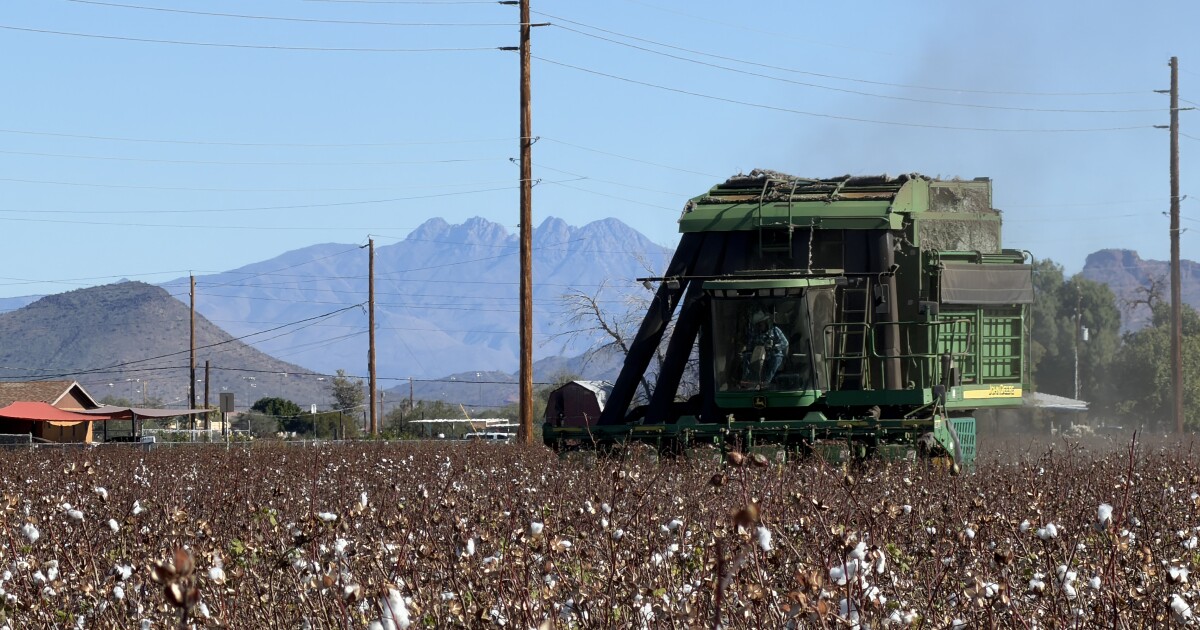
American cotton growers are in search of some good news heading into spring planting.
Brazil has surpassed U.S. farmers in exports, while China is boosting production of man-made fibers, making them even more cost-competitive with American cotton, industry experts say.
“Our production is outpacing what demand is,” Abigail Hoelscher, senior market analyst at Texas-based Plains Cotton Cooperative Association, said at USDA’s annual Agricultural Outlook Forum.
She said the cost of producing U.S. cotton has increased 164% since the 1990s while yields have increased relatively modestly. Meanwhile, Australia and Brazil have lower costs of production for cotton, and petroleum-based man-made fibers are seizing an ever-larger share of the global fiber market.
According to USDA’s latest cotton outlook, global textile fiber consumption grew from 337 million to 520 million bale-equivalents from 2007 through 2024, but cotton’s share of that market plummeted from 35% to just 22%.
Meanwhile, USDA sees little improvement in cotton prices for farmers this year . The average farm-gate price for the 2026 harvest is expected to be 63 cents per pound, just three cents higher than last year’s crop, according to the department’s outlook.
 Graham Soley (Agri-Pulse photo)
U.S. production costs range from the high 60 cents per pound to more than 80 cents per pound, according to Hoelscher.
Graham Soley, a former USDA economist who is now at Shearwater Commodity Research, noted that China now accounts for 30% of global cotton production as well as one-third of consumption and is the second-largest exporter of finished products, all at the same time that it has also been increasing its production of man-made fibers.
The Uyghur Forced Labor Prevention Act (UFLPA), which restricted U.S. imports from Xinjiang province, has had little impact on Chinese cotton production, which has grown to 36 million bales, most of which is grown in Xinjiang, he said. By comparison, U.S. growers produced about 14 million bales last year. Meanwhile, Xinjiang’s spinning capacity has increased to 30 million bales, comparable to three Vietnams, he said.
Hoelscher presented a series of questions that face the industry, including this one: “Does cotton become a niche fiber, more like wool?”
A piece of legislation that could help reverse the industry’s fortunes, in her view, is the Buying American Cotton Act, which would authorize a tax credit to apparel manufacturers that use U.S. cotton. The credit would be available to foreign as well as domestic manufacturers but would be larger for U.S. plants.
“It’s more of a stabilizer and not a savior. But right now, we need that stabilization,” she said. “There’s really no structural incentive right now for those retailers to buy our cotton whenever our cotton is a little bit more expensive.”
Long-term soybean exports headed down?
USDA is projecting a rebound for soybean exports in 2026 on China’s resumption of U.S. purchases, but USDA’s Bryn Swearingen said at the Outlook Forum that the purchase commitments won’t be sufficient to reverse the industry’s trend of declining exports.
China has committed to purchasing 25 million tons of U.S. soybeans in each of the next three years, according to the White House. Accordingly, USDA is anticipating exports to rebound in the 2026-27 marketing year from around 1.58 billion bushels to 1.7 billion. But Swearingen warned that the industry would likely resume its downward export trend in the following years.
 Bryn Swearingen (LinkedIn photo)
“Overall, the US export market share is likely going to continue its long-term decline, largely on competition for other exporters such as Brazil,” she said.
But the picture is brighter for soybean derivatives, Swearingen noted. U.S. crush capacity will continue to expand, she said. Expanded port capacity in the Pacific Northwest will help drive export growth in soybean meal exports, as will rising global demand.
Soybean meal exports are expected to grow from 19.4 million tons in the 2025-26 marketing year to 20.8 million in 2026-27, USDA notes in its latest outlook.
Soybean oil production is set to expand by more than a million pounds in the same time period and domestic use is expected to grow. Higher renewable volume obligations and adjustments to the 45Z biofuel tax credit to incentivize domestic feedstock use are set to spur soybean oil use as a biodiesel feedstock, she noted.
Bottom not here yet for egg prices
After two straight years of wild price swings for eggs amid bird-flu outbreaks, the average wholesale price per dozen is forecast at $1.25 this year, down from an average of $3.74 in 2025, according to USDA. The outlook assumes no additional diseases hurting flocks.
The decline, if it holds, is likely to drive a talking point among Republicans in this year’s midterm campaigns following a 2024 surge in egg costs that GOP candidates including Donald Trump used to criticize Democrats.
USDA sees total domestic egg output falling 4% last year from 2024, mostly due to bird flu. This year, production is forecast to rise 6% as the flock is rebuilt.
Americans’ protein passion to bolster prices
America’s love of specialty cheese and butter will lift U.S. dairy imports, while bigger domestic milk production is poised to propel exports of milkfats.
Booming domestic demand for protein is expected to keep prices elevated for key dairy items, leaving fewer available to sell into the global market, according to the USDA’s outlook. Export growth for products like whey and lactose is projected to be flat, USDA said.