Lea el artículo en español aquí.
As the first signs of new seasonal growth appear across North Coast vineyards, the California wine industry got its first official look March 13 at the size and value of last year’s crop as vintners continue to adjust to weaker consumer demand and lingering inventories.
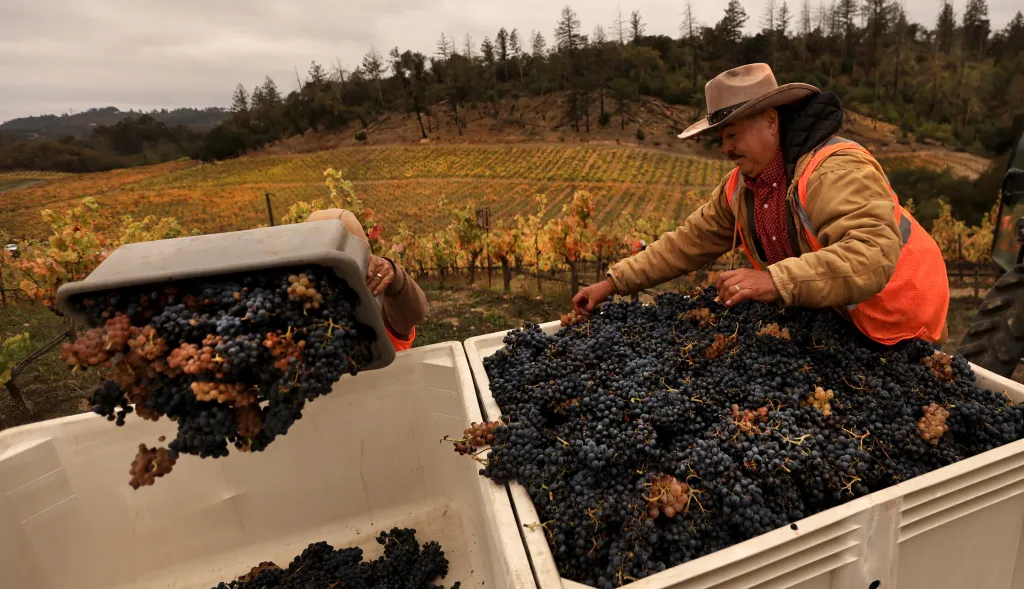
The preliminary report from the U.S. Department of Agriculture’s National Agricultural Statistics Service, released a month later than usual, shows wineries last year crushed about 2.62 million tons of wine grapes in the Golden State and 436,000 tons in the North Coast, each down just over 8% from 2024.
The figure confirms what industry watchers expected would be a continued drop in production. It also marks the smallest statewide crop in more than two decades and the lightest in the North Coast since 2021.
Sonoma County grapes crushed totaled 185,500 tons, down 13.5%; Napa County, 144,000 tons, down 2.2%; Mendocino nearly 64,000 tons, up 1.8%; and Lake County, almost 43,000 tons, down nearly 16%.
The value of the North Coast crop was $1.33 billion, down 13%. But a combination of lower pricing and tonnage statewide pushed its value proportionately lower, off by almost 16%, to $2.41 billion.
But industry analysts say the North Coast numbers also contain a few anomalies, and they caution that the county average prices in the report can obscure current market conditions for growers seeking new contracts.
“Bud break,” or the emergence of new vine shoots after winter dormancy, was seen in Napa, Sonoma Mendocino, Lake and Solano counties in early March. That’s about one to two weeks ahead of or behind typical timing, depending on the area, according to Glenn Proctor, partner at San Rafael-based grape and bulk wine brokerage Ciatti Co., and Christian Klier, North Coast grape broker for Novato-based Turrentine Brokerage.
But the forecast temperatures in the 80s this week are expected to accelerate this stage of the season.
-

Preliminary 2025 figures for North Coast and California wine grape value, calculated from the California Grape Crush Report released March 13, 2026. (Jeff Quackenbush / North Bay Business Journal / Datawrapper)


1 of 8
Preliminary 2025 figures for North Coast and California wine grape value, calculated from the California Grape Crush Report released March 13, 2026. (Jeff Quackenbush / North Bay Business Journal / Datawrapper)
A historically small crop
Klier said the statewide figure underscores how far the industry has been restructuring its supply from the peak 4 million-ton harvests of the past decade.
The California crop last year was 19% below the recent five-year average. And the smaller 2024 and 2025 harvests resulted in the equivalent of 72 million fewer standard 9-liter cases of wine being added to inventory since 2023, when sales of bottled wine started to significantly slow.
For the North Coast, the crop last year was 5.5% below average, and the last two smaller crops resulted in 7.34 million fewer cases since 2023.
“The decrease in tons is still very positive news for the industry overall,” said Steve Fredricks, president of Turrentine, in a news release.
The smaller crop reflects a combination of factors, including vineyard removals, soft wine demand and seasonal challenges in vineyards.
“Between a cooler growing season, reduced vineyard inputs, and multiple rain events which led to excessive late-season disease pressure and combined with soft demand, 2025’s challenges were relentless,” stated Audra Cooper, the firm’s vice president.
North Coast data anomalies draw scrutiny
While the overall trend toward smaller harvests was expected, some county-level figures in the report have raised questions among brokers reviewing the data.
One example involves Mendocino County Cabernet Sauvignon production.
“It’s doubled from the previous year,” Klier said.
Given recent thousands of acres vineyard removals and production trends in the region, Klier said the nearly 20,000 tons of Mendocino cab crushed appears implausible and may reflect a reporting error. That would be more than double the 9,717 tons crushed in 2024 and 51% above the five-year average.
The crush report gets updated at least twice annually. The next scheduled release is by the end of April.
Another unusual data point involves Chardonnay pricing in Lake County: $247 a ton, which would be 84% lower than the $1,548 county average for 2024 and 76% below the five-year average.
“Lake County Chardonnay is always screwy, because there’s not that many tons,” Proctor said. Just over 1,000 tons of the white grapes from the county were crushed last year, a 32% drop from 2024 and 28% below average.
And further analysis would be needed into reported prices paid between the vineyard and winery operations of the same company to sort out this price oddity, he said.
Prices lag market reality
Another complication in interpreting the crush report involves the way grape prices are reported.
District averages often reflect long-term contracts negotiated years earlier, many of which from prime Napa and Sonoma county suppliers include annual price increases. That means official averages may not reflect the lower prices currently being offered for new contracts.
“I think we probably have another two years before we actually see the district average reflect today’s pricing market for Sonoma County Pinot Noir and Napa County Cabernet,” Klier said.
Pinot pricing in Sonoma County last year averaged $3,687 a ton, up 9% from 2024 and nearly the same proportion above the five-year average. Napa Cab pulled back from the $9,000-a-ton average of 2023–2024, settling nearly 3% lower at $8,864, but still above the five-year trend.
Sonoma County’s king grape, Chardonnay, averaged $2,367, down 8.1% from 2024 and almost 3% below the trend.
While North Coast Sauvignon Blanc, led by Lake County, was the only major varietal to see tonnage increase overall last harvest, pricing was down 12% in Lake and Mendocino counties, 7% in Sonoma and almost 4% in Napa.
Klier said competition from new Sauv Blanc acreage in the Central Coast and Central Valley is pressuring North Coast pricing.
Battling the bulk
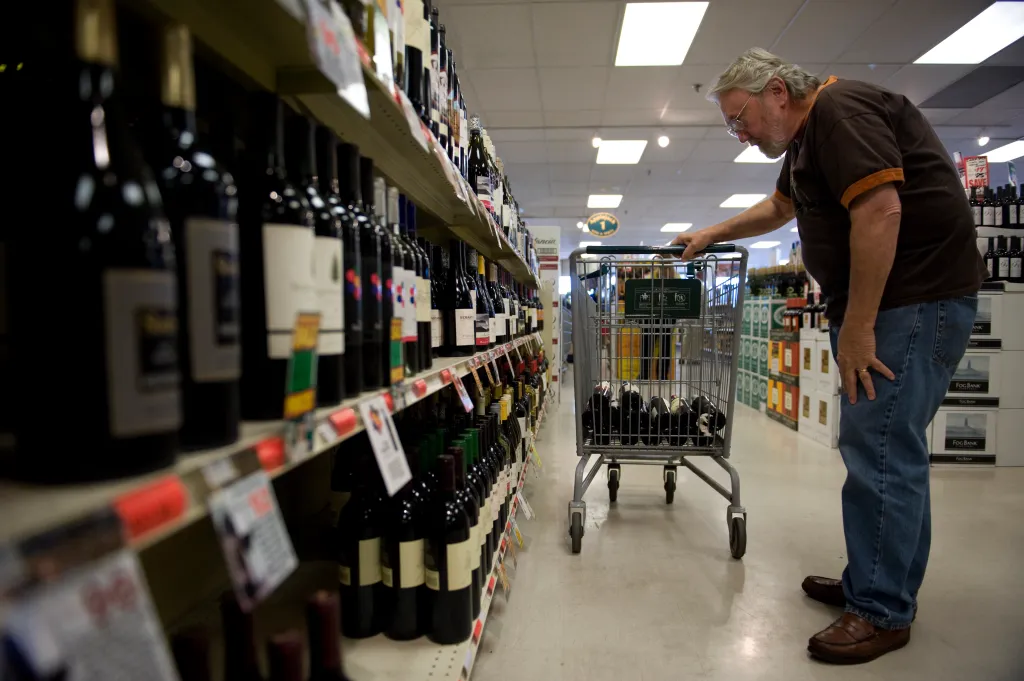
Another major factor shaping grape demand is the large volume of excess wine still available for sale from wineries in bulk.
Ciatti estimates roughly 38 million gallons currently listed on the California bulk market — a level close to recent highs.
“Our expectation is we’ll see activity purchasing off the bulk market, and then we see subsequent grape activity,” Proctor said.
However, he cautioned that much of that inventory includes older vintages that may become increasingly difficult to sell. A significant portion of wines listed for sale are from prior years, which makes them less attractive to buyers focused on current releases or fresh bottlings.
For example, 49% of the available bulk California Chardonnay is vintage 2024 and earlier, Proctor said.
Older vintages can be harder to market because wineries often prefer wines that align with their current product lines and release schedules. As those wines age, they may eventually have to be discounted heavily or blended into other products to move.
“You don’t want to confuse activity with positivity. We’ve got activity. We’re moving some inventory, but they’re tough deals,” Proctor said.
Growers face difficult choices
The combination of lower demand and large inventories has left many growers without secure contracts.
Klier said the pressure has already led to widespread vineyard removals across California’s wine regions, including in the North Coast.
“The growers have been suffering. If you’re out of contract, it’s very difficult to find a contract,” he said.
Some growers without contracts have turned to custom-crush facilities, choosing the risky route of making wine themselves rather than sell grapes at depressed prices.
Others are considering whether to continue the practice of the last two seasons of reducing vineyard management costs if buyers do not emerge this season.
“If there’s not a buyer, are they going to farm it normally for the whole year, to sell it at some discounted price at the end, or are they better off pruning it and just mothballing it,” Proctor said.
That decision — whether to fully farm vineyards or temporarily scale back — is now unfolding just as the new growing season begins.
Uncertain outlook for the next vintage
Proctor said the industry may need a significantly smaller crop before prices recover more decisively.
“My guess is, if we did have an under 2 million-ton crop, there would have been a little more excitement,” he said.
Instead, the market appears to be settling into a slower adjustment period.
“I think ’26 right now feels pretty cautionary,” Proctor said.
Jeff Quackenbush joined North Bay Business Journal in May 1999. He covers primarily wine, construction and real estate. Reach him at jeff@nbbj.news or 707-521-4256.