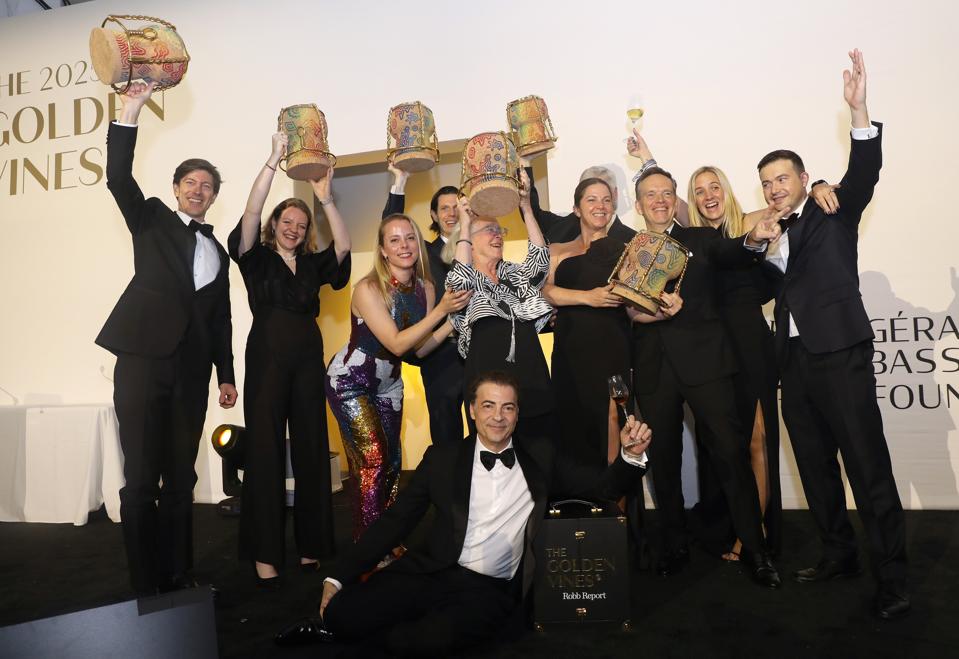
On November 8, 2025 in the electric hum of Miami’s Faena Forum, a breakdance crew spun beneath a cascade of Dom Pérignon P2 Vintage 2008 (the first public pour of a wine not yet released) while 830 wine experts from 100 countries cast ballots to crown the world’s finest producers. I was attending the Golden Vines Awards, the “Oscars of fine wine,” where empire-builder Lewis Chester has designed a constellation of glamour, gastronomy, and philanthropy. Before this night arrived, however, I was given a crash course on the difference between exceptional wine and the world of fine wine where Chester plays.
For my 2018 solo road trip through Portugal, driving from Lisbon to Porto to Evora to the Algarve while stopping in towns in-between, my sybaritic Sicilian friend, to whom I frequently send restaurant wine lists for advice on which to order, insisted I not leave the land of cork and vine without a bottle of Quinta do Crasto. After my third failed attempt to find this seemingly mythic elixir, I began asking every shopkeeper thereafter if the bottle was worth the exceedingly frustrating quest.
With a dramatic pause and a solemn eye-to-eye gaze, all would reply, “Senhora, it’s the best.” I finally found two bottles in the Algarve shortly before driving back to Lisbon airport. During my Zoom interview with London-based Chester, I proudly showed off my remaining bottle kept for a special occasion, looking to impress this master of the oenophile universe with my hard-won acquisition.
“Lilian,” he calmly said. “I’m sure it’s a good wine, but I deal in fine wines.”
Fine wine, he explained, is artisanal, low-yield, terroir-driven, critically validated, capable of aging for decades, and supported by a secondary market where it trades like a commodity. “I know nothing about wine,” he continued. “I know a lot about fine wine. I know a lot about Ferraris, but I know nothing about Volkswagens. They’re very different products.”
My Quinta do Crasto, however revered it was throughout Portugal, was a trusty and reliable Volkswagen in Chester’s world of Ferraris. Both get you there; only one appreciates in value.
From Oxford to the Oscars of Fine Wine
“I was trying to find drugs, couldn’t find any, so I started a wine club at Trinity College,” Chester said of the genesis behind the world’s most exclusive wine event.
Raised in a teetotal, non-smoking family, he discovered wine at Oxford’s Trinity College. After Oxford came a legal career, followed by Harvard Business School, where he founded the Churchill Club, a members’ society devoted to wine, whiskey, and contraband Cuban cigars. Returning to the UK in the late 1990s, he began collecting; whiskey first, then wine, with his collection periodically passing through Sotheby’s as he refined his “distinct style and DNA.”
Through collecting, he met Gérard Basset, the only person on record to simultaneously hold titles of Master Sommelier, Master of Wine, and World’s Best Sommelier. “He took me under his wing and said, ‘what do you want to be in the world of wine?’” Chester recalled. “And like most Harvard Business School grads, I said, ‘I want to be the world’s most important collector.’”
His MBA calculation yielded Liquid Icons, the research house he and Basset co-founded and the intellectual engine behind the Gérard Basset Global Fine Wine Report. Verified by Deloitte and drawing on over a thousand industry professionals, the report shifts conversation from individual vintages to estates as long-term asset names.
“Which estate is making the best wines in Europe? Which estate is the best rising star? Because my belief was, if we could identify the best estates, all of their wines are going to be great, and they’re likely to be the best to have an asset name.”
Basset died in January 2019, two years before Chester and business partner Sasha Lushnikov launched the Golden Vines in London 2021. It’s since become an annual nomadic circuit across Florence (2022), Paris (2023) and Madrid (2024) before making its 2025 U.S. debut in Miami.
“Golden Vines is built on four pillars,” Chester illustrated: celebration, respect, charity, and fun. “Without the charity, there wouldn’t be a Golden Vines.” On fun: “If you are a wine geek like me, and you go to a lot of wine events, you’ll find that they are extremely boring and tend to be very male-dominant.”
Golden Vines, by design, is neither. It’s essentially a high-octane fusion of red-carpet prestige, Michelin-starred indulgence, and data-driven validation elevating producers into canonical status while fueling philanthropy. All for the tax-deductible access of $15,000 per person.
The Oscars Of Fine Wine’s Weekend Of Wonders

MIAMI BEACH, FLORIDA – NOVEMBER 08: A view of awards during The 2025 Golden Vines Awards Gala at Faena Forum on November 08, 2025 in Miami Beach, Florida. (Photo by Aaron Davidson/Getty Images for the 2025 Golden Vines)
Aaron Davidson/Getty Images for The Golden Vines®
In Miami, guests moved through 34 experiences over a weekend, beginning with Friday masterclasses in Iconic Women in Wine, South American All Stars, and exclusive sessions with Dom Pérignon and Krug before an opening gala dinner at Miami’s historic Alfred I. duPont Building. Graham’s 50 Years Old Tawny en Rehoboam closed an evening begun with a rare rosé Champagne en Jeroboam and a gastronomical journey curated by Michelin-starred Chef Ryan Ratino.
Château Cheval Blanc, Harlan Estate with Dom Pérignon Plénitude 3, and Château Lafite Rothschild alongside Trimbach Clos Ste Hune each hosted lunches on Saturday in advance of the awards gala led by another multi-Michelin-starred chef, Kyle Connaughton. Courses arrived with pours of Château Lafite Rothschild 1989 en Impériale, a Colgin IX Estate 2003 en Magnum, and the global premiere of Dom Pérignon Plénitude 2 Vintage 2008. Trophies by artists Nuria Mora and Jen Stark arrived in custom Gucci trunks.
Sunday options ranged from a private jet excursion to the Exuma Islands to dine with newly minted Michelin-starred Chef Masayuki Komatsu and hosts Jean Fourrier, Charles Lachaux, and Richard Geoffroy, to a white truffle and fine wine lunch with Masseto at master watchmaker F.P. Journe’s Miami boutique.
“Wine is sharing,” Guillaume Lete, chef de cave for Champagne Barons de Rothschild (a project uniting all three branches of the Rothschild family: Lafite, Mouton, and Edmond) told me over Zoom from Champagne, France. “A meeting between different kinds of people who share the same values, the same goal, the same aim at the end.”
Sponsoring the Golden Vines Miami was a first for the 250-year-old Champagne house with the most recognized name in the industry. It donated bottles, underwrote lunches and dinners, and showed up to meet students and collectors.
“If it’s in London, or if it’s in Paris, or if it’s whatever, we will follow,” Lete said, pleased with the soirée’s ROI. “Because it is for the spirit around this event, and for why they do this event — to help the people. That’s the thing that is important, and the place is after.”
The Oscars Of Fine Wine Surfaces A Quiet Icon

MIAMI BEACH, FLORIDA – NOVEMBER 08: Jen Stark and Cathy Corison attend The 2025 Golden Vines Awards Gala at Faena Forum on November 08, 2025 in Miami Beach, Florida. (Photo by Aaron Davidson/Getty Images for the 2025 Golden Vines)
Aaron Davidson/Getty Images for The Golden Vines®
“I don’t make wine. Mother Nature makes wine,” Cathy Corison, 2025 Golden Vines Frédéric Panaïotis Sustainability Award winner, told me over Zoom from her eponymous Napa Valley winery. “I can’t make the wine any better than the grapes that come in the door.”
A farmer by her own definition, Corison has spent five decades studying canopy management, or the art of controlling how sunlight and air reach grapes. Five decades earlier, after finishing her master’s degree in winemaking, her professor told her to choose another career because women would never work in Napa Valley. According to superstition, menstruation would ruin a batch. She didn’t argue.
“I just heard this little voice on my shoulder,” she recalled, “and it said, ‘watch me.’” She’s since put 39 vintages in barrel.
Corison has farmed her vineyard organically for 29 years, long before it became fashionable or certifiable, neither of which she’d given much thought beyond it being the best way to yield a delightful batch. She also hadn’t given much thought to the Golden Vines, of which she wasn’t familiar until Steve Matthiasson, a fellow Napa winemaker and Golden Vines judge, suggested she apply. She won nonetheless. By Chester’s design, Golden Vines is meant to surface the already virtuous, not reward glossy, PR-promiscuous brands without a north star.
“What I love about wine is that it’s alive,” she enthused. “And that it’s a whole series of living systems that conspires to what is really alchemy. We don’t even understand it that well. Don’t let us fool you.”
On my last outing to the Concours Club Miami, I mentioned my interview with Corison to Dan Pilkey, the motor sports club’s sommelier. He reacted as if I’d said Beyoncé.
“Cathy Corison, are you kidding me?” His excitement crystallized her Golden Vines win. “She’s in the middle of Robert Parker country and big, juicy Cabernet, and she’s always maintained this amazing level of humbleness. She’s just done so well.”
What the Oscars of Fine Wine Delivers Beyond the Bacchanal
Wine, Corison advised, is a form of infinity. It can meet you at any level, from washing down a meal to a lifetime of study. But pretension, she said, “gets in the way. It gets between people and wine. It intimidates people. We don’t want to intimidate people; we want to welcome people.”
Which brings me back to my Portugal quest. Where Chester placed Quinta do Crasto outside his universe, Corison vindicated my triumph. “That wine is one of the great wines of the world, regardless of its price.”
But this is also Chester’s triumph. Without the Golden Vines, I would never have learned how a group of tipsy aristocrats are paving way for underprivileged women in patriarchal societies to access a stratosphere otherwise beyond reach.
While lauding the Bacchanalian pursuit of luxury in a Golden Vines weekend seems tone-deaf during the current geopolitical strife, the money raised from the Miami rendition has now launched careers for the two Gérard Basset Foundation 2025 scholarship winners: Iranian Leila Killoran and Ukranian Sera Karamshuk.
And thus is the paradox of Lewis Chester’s empire. An event engineered for the 1% of the 1% exists to dismantle walls keeping out the other 99%. His mentor, Gérard Basset, came from the same humble beginnings as every scholarship recipient The Foundation has awarded.
“We work in over 20 countries in the world,” Chester said. “It’s principally about young people from diverse backgrounds and giving them the tools through paying for their education and work internship. We’re the biggest charity in the world doing this because we’re the only charity in the world doing it.”
What the C-Suite Can Learn From the Oscars of Fine Wine

MIAMI BEACH, FLORIDA – NOVEMBER 08: A view of Dom Pérignon during The 2025 Golden Vines Awards Gala at Faena Forum on November 08, 2025 in Miami Beach, Florida. (Photo by Aaron Davidson/Getty Images for the 2025 Golden Vines)
Aaron Davidson/Getty Images for The Golden Vines®
Golden Vines could have just been another hedonistic event for the world’s wealthiest collectors. Instead, Chester fused spectacle, data, and philanthropy into a single ecosystem where each element legitimizes the others. The C-suite lessons translate well beyond wine:
-
Engineer the asset, then the event. Chester built a data engine (Liquid Icons and the fine‑wine report) before he built the Golden Vines stage. The awards feel glamorous because they ratify a system of credibility beyond a red carpet. Winners aren’t chosen by opinion.
-
Use luxury theater to fund real access. A $15,000 weekend is easy to critique until you follow the money into scholarships and education programs. If you’re staging indulgence, make sure dividends are legible and transformative for people without access to the room.
-
Surface the already virtuous. Golden Vines gave a spotlight to Cathy Corison’s 29 years of organic farming and Rothschild’s generational stewardship. When recognition platforms reward proven substance over loud PR budgets, they defend the integrity of a craft now saturated with celebrity names on white-label bottles.
-
Design for joy and justification. Chester emphasized the importance of fun alongside charity. Productions to educate and convert high‑value advocates rarely look austere. The trick is to let joy be the on‑ramp to deeper engagement.
In his mission to build a global ecosystem where scarcity, status, and social purpose converge, Chester walked away from a career managing other people’s money to do Golden Vines full‑time, a trade he says only makes sense if the event changes more than just the price of a few bottles.
“We did programs for people of color, Ukrainians, disability students, women in Japan and in India, where it’s difficult to get into the industry, economic disadvantage. Basically, we’re covering wherever there is a problem in the world. That’s where we’re trying to focus and create a more inclusive society.”
The money he’s raised has now funded 66 scholars from 28 nationalities and 23 countries toward a Master of Wine and Master Sommelier designation via The Gérard Basset Foundation. The glamour of the Oscars of fine wine has only ever been the means. The Foundation and those it serves is the point.