Published by:


Ask a clinical question and tap into Healio AI’s knowledge base.
- PubMed, enrolling/recruiting trials, guidelines
- Clinical Guidance, Healio CME, FDA news
- Healio’s exclusive daily news coverage of clinical data

March 30, 2026
3 min read
Women with gestational diabetes who have good glycemic management have similar odds of having offspring with obesity as women without gestational diabetes, according to data published in Diabetes Care.
“Gestational diabetes can understandably feel overwhelming for many pregnant women,” Rana F. Chehab, PhD, RD, staff scientist in the division of research at Kaiser Permanente Northern California, told Healio. “Our findings suggest that timely glucose regulation after diagnosis may play an important role in shaping a healthier metabolic environment for the developing baby. With appropriate care and support, many women with gestational diabetes are able to achieve healthy glucose levels, and this may help mitigate risks for the next generation.”

Chehab and colleagues conducted a prospective cohort study of 206,464 pregnant women who gave birth at Kaiser Permanente Northern California from 2011 to 2017. Pregnant women were screened for gestational diabetes at 24 to 28 weeks’ gestation. Glycemic management trajectories among women with gestational diabetes were determined through laboratory glucose values. The four trajectories were stable optimal glucose, rapidly improving to optimal, slowly improving to near optimal and slowly improving to suboptimal. BMI and obesity in offspring were determined from height and weight measures at ages 2, 4, 6, 8 and 10 years.
Of women in the study, 7.2% were diagnosed with gestational diabetes. Among the gestational diabetes subgroup, 39.4% had stably optimal glucose, 32.1% were rapidly improving to optimal, 16.8% were slowly improving to near optimal and 11.7% had slowly improving to suboptimal glucose.
At all ages, mean BMI and risk for obesity increased with worse glycemic management trajectory. At age 10 years, women in the stable optimal trajectory group had a similar risk for having a child with obesity as those with gestational diabetes. However, risk for obesity in offspring at age 10 years was increased for women with rapidly improving to optimal glucose (RR = 1.37; 95% CI, 1.18-1.59), slowly improving to near optimal glucose (RR = 1.53; 95% CI, 1.29-1.81) and slowly improving to suboptimal glucose (RR = 1.62; 95% CI, 1.33-1.98) compared with women without gestational diabetes. The findings were similar at other ages.
“One reassuring finding from our study was that women who achieved timely glucose regulation soon after diagnosis had children whose risk of obesity was similar to that observed among children of mothers who never had gestational diabetes,” Chehab said. “This suggests that early and effective glucose management may substantially mitigate the elevated risk associated with gestational diabetes.”
Differences in mean BMI and obesity risk for offspring attenuated in models adjusting for prepregnancy BMI, though women with slowly improving to suboptimal glucose still had increased risk for offspring with obesity at age 6 (RR = 1.22; 95% CI, 1.07-1.39) and age 8 years (RR = 1.22; 95% CI, 1.05-1.42) than women without gestational diabetes.
Most glycemic management trajectories were not associated with offspring BMI or obesity risk at any age among women with either healthy weight or underweight prepregnancy. Among women with overweight or obesity before pregnancy, women with gestational diabetes and slowly improving to near optimal glucose (RR = 1.23; 95% CI, 1.03-1.47) and slowly improving to suboptimal glucose (RR = 1.31; 95% CI, 1.08-1.6) were more likely to have a child with obesity at age 10 years than women without gestational diabetes.
Chehab said the study reveals how important it is for pregnant women with gestational diabetes to reach glycemic control as soon as possible after diagnosis through nutrition therapy, physical activity and medication or insulin.
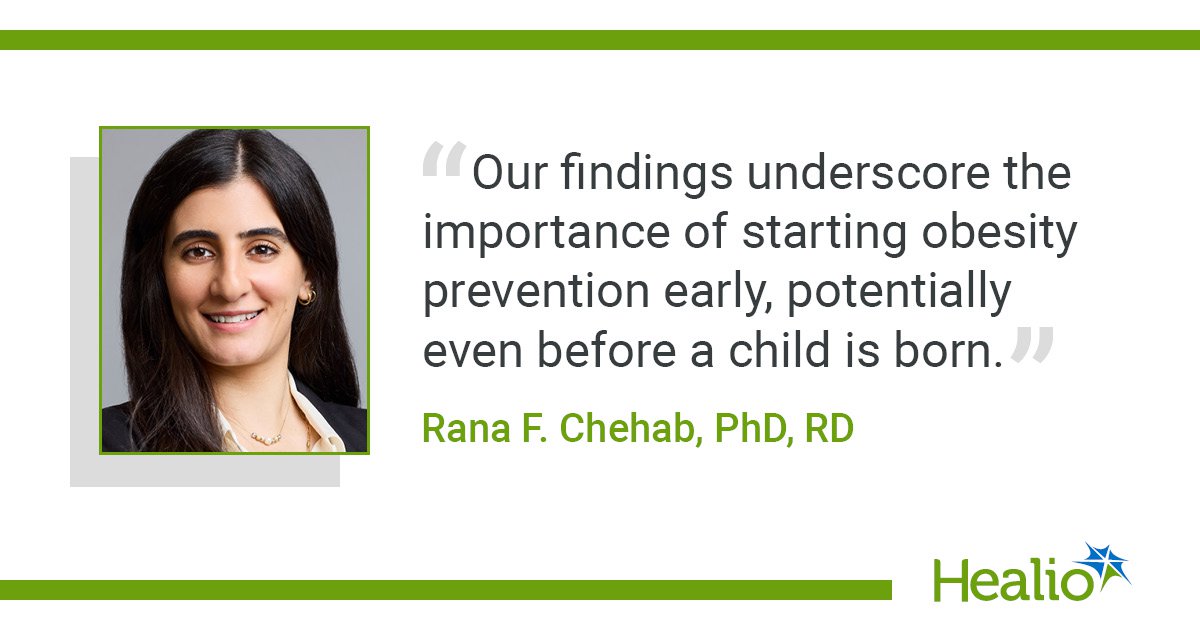
“More broadly, our findings underscore the importance of starting obesity prevention early, potentially even before a child is born,” Chehab said. “Maintaining healthy blood glucose levels during pregnancy may help reduce fetal exposure to high glucose levels in utero, which is believed to play a role in shaping long-term metabolic health and obesity risk in children.”
Chehab said future research should assess factors that may allow women with gestational diabetes to reach healthy glucose levels faster than others, adding that information could allow health care professionals to create personalized care strategies for patients.
Rana F. Chehab, PhD, RD, can be reached at rana.chehab@kp.org or LinkedIn @RanaChehab.
Ask a clinical question and tap into Healio AI’s knowledge base.