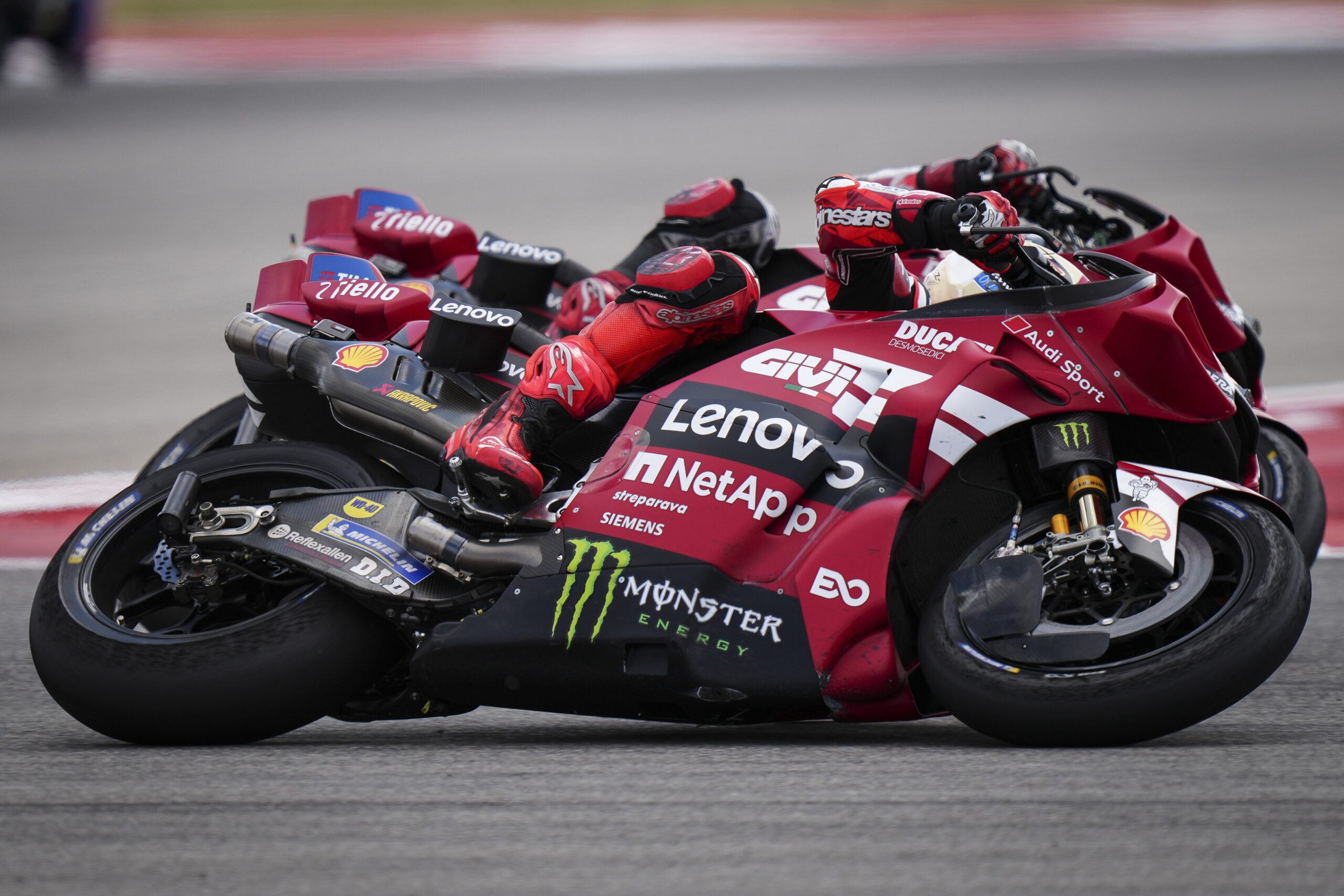
There are many reasons why MotoGP™ bikes use carbon brakes, the primary ones being performance and safety. Carbon is able to provide the extreme braking performance at high speed which is demanded by a MotoGP™ motorcycle, doing so in a consistent, reliable manner.
Carbon’s thermal resistance, lightweight properties and elite-level stopping power make it the go-to choice for brake manufacturers and teams in MotoGP.
What are carbon brakes?
MotoGP™ carbon brakes consist of a brake disc – also referred to as the rotor – and a brake pad that are both made from carbon-carbon composite material, which is a carbon fibre reinforced with carbon matrix.
To brake, a rider applies pressure to the brake lever on their motorcycle, and the pad comes into contact with the rotor, creating friction that stops the wheel’s motion. Carbon has exceptional thermal compatibility and friction characteristics, which make it ideal for the forces required to resist the excessive heat generated by the levels of intense braking encountered in MotoGP™. Carbon is also highly resistant to warping and cracking under thermal pressure.
Carbon brakes were originally developed in aerospace and defence for use on aircraft, and then adapted for motorsport where they were adopted in Formula 1 in the late 1970s, really coming to the fore in the 1980s. In the same decade, they were introduced into 125cc, 250cc and 500cc classes.
The uptake of carbon brakes was, and remains, down to their ability to withstand repeated, high-energy braking that inflicts forces and temperatures that steel rotors cannot sustainably handle.
It’s important to note the difference between carbon-carbon brakes and carbon ceramic brakes, which are used on high-performance road cars and are a different material structure. Carbon ceramic discs are optimised to work across a broad temperature range, including cold conditions. This makes them ideal for road use. Carbon-carbon brakes need high operating temperatures to reach optimal operation.
Why carbon brakes are perfect for MotoGP
Carbon brakes are ideal for the demands of MotoGP™ for a number of reasons. Firstly, their stopping power is unmatched. Carbon-carbon composites generate extremely high friction coefficients at operating temperature, which produces greater braking force than steel systems. In a heavy-braking zone such as Turn 1 at Circuit of the Americas, a MotoGP™ bike can decelerate from over 340km/h to 100km/h in the space of a few seconds.
Resistance to heat is another advantage – MotoGP™ carbon brakes can withstand sustained temperatures of 1000ºC with no structural deformation or degradation. In fact, carbon brakes improve their friction performance as temperature rises. They also perform consistently through a race, providing reliable feedback for a rider and experiencing minimal brake fade.
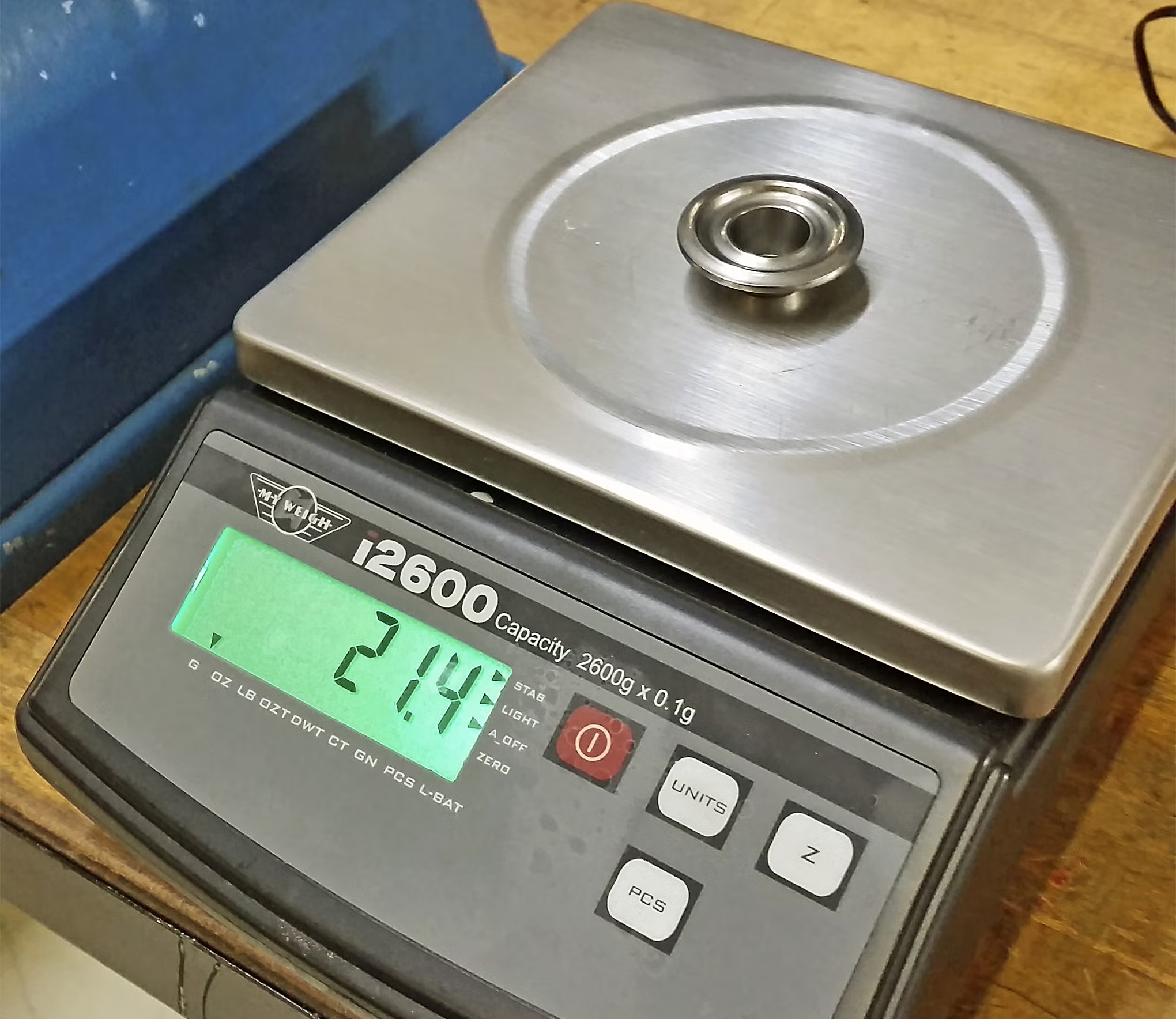
Carbon also carries a significant weight benefit. A full MotoGP™ front carbon brake disc weighs around 1.2 kg in the 340 mm version and about 1.4 kg in the 355 mm version. By comparison, a steel disc such as the one used in WorldSBK weighs approximately 2.2 kg and was also the solution historically adopted in MotoGP™ wet conditions.
Defining the exact weight a steel disc would need to withstand MotoGP™ use without deformation is not straightforward, as it depends on multiple factors beyond size alone. The reduced mass of carbon discs helps lower unsprung weight, improving suspension response and overall bike handling.
How hot do MotoGP™ brakes get?
A front MotoGP carbon brake disc’s temperature range during a race typically runs from 600ºC to in excess of 1000ºC, with 1000ºC+ regularly measured at the most demanding braking circuits such as Spielberg, Motegi and Buriram.
MotoGP riders brake extremely late, compressing the braking distances into the most compacted, demanding limits and placing huge stress on the brakes. The sheer amount of kinetic energy which must be dissipated through the brakes due to the massive speed decelerations is heightened further by the amount of downforce and tyre load on the wheel.
This amount of force generates intense temperatures as previously mentioned, and this is why MotoGP bikes use carbon brakes. Carbon-carbon composites need to reach a minimum of 200ºC before they achieve an effective friction performance. Anything lower, and braking power reduces significantly and – more dangerously – becomes inconsistent.
Therefore, the kinds of temperatures a MotoGP front brake reaches in a race draws out the best braking performance. These temperature requirements are carbon’s strength, in terms of its optimal performance at race temperatures, but also weakness as cold conditions, especially at the start of a race, cause issues.
For this reason teams use brake duct covers and insulating materials to aid temperature control and maintenance in the moments when the brakes are not sufficiently hot.
Carbon brakes vs steel brakes
Carbon and steel brakes offer very different performance outputs depending on specific scenarios.
Below is a table comparing the two materials across some of the key performance areas for MotoGP brakes.
Carbon vs steel brakes in MotoGP:
|
|
Carbon brakes |
Steel brakes |
|
Performance |
● Superior stopping power at race temperatures ● Optimal friction coefficient peaks at <600ºC ● Consistent performance under intense heat conditions |
● Adequate performance for road and less demanding race levels ● Lower friction coefficient at its optimal level ● Degrades significantly under sustained and heavy use |
|
Warm-up requirements |
● Needs to reach 200ºC before delivering full performance ● Less responsive when cold
|
● Effective in ambient and cold temperatures ● Less demanding requisites for functionality ● Has advantage for road use and much shorter events |
|
Wet conditions |
● Wet conditions significantly reduce disc temperature, which results in performance drop-off ● Water on rotor/pad interferes with friction |
● Performs adequately in wet weather conditions ● More predictable and consistent stopping power when temperature cannot be maintained due to wet |
|
Weight |
● Carbon disc: 1.2-1.4kg ● Significant weight saving |
● Steel disc: 2.2kg (WorldSBK) ● Considerable weight disadvantage |
|
Durability |
● Need replacing regularly for MotoGP demands ● Lasts for a maximum of 2 Grand Prix weekends |
● More durable for general use ● Would need regular changing under MotoGP™ conditions due to thermal stress |
|
Cost |
● Extremely high ● A MotoGP™ team is allowed to spend up to €70,000 per season on a front brake kit (FIM cap, which includes allowance of 10 carbon discs and 28 pads) |
● Very reasonable ● High performance road and lower level racing steel discs can cost up to €600 per disc, depending on spec |
Why carbon brakes are harder in the rain or cold
As previously stated, carbon needs heat to operate efficiently. Its friction performance is dependent on temperature, and below 200ºC that friction is just not generated, which results in a reduction of braking performance to low levels. Even aggressive braking in cold conditions will not bring the brakes up to the temperature needed.
Rainwater on the brakes acts as a coolant, therefore affecting temperature, and water between the brake disc and pad directly affects their interfacing. All of this leads to unpredictable performance, which can make MotoGP™ carbon brakes hazardous under racing conditions when it’s wet or cold.
Today, however, carbon brakes are still used in wet races as well, with the addition of protective covers designed to limit water contact with the disc and help stabilize performance.
Why road bikes don’t use carbon brakes
There are a number of reasons why road motorcycles generally don’t use carbon brakes. One major factor is cost – carbon brakes are simply too expensive. A full front MotoGP™ braking system can cost up to €20,000.
Aside from the prohibitive cost, there’s also the required temperature levels for carbon brakes to work effectively. Everyday road conditions – both weather and traffic – cannot offer what’s needed to get carbon brakes up to operational temperatures, and using carbon brakes at such low temperatures would be both dangerous and counterintuitive.
Carbon brakes are also high maintenance and require specialist inspection not offered by regular motorcycle workshops. Carbon reacts badly to contaminants such as oil, grime and water, and safety regulations require brakes to operate at ambient temperatures, something elite-level racing carbon brakes cannot guarantee.
Who supplies MotoGP™ carbon brakes?
Brembo is currently the brake supplier of all MotoGP™ teams. As opposed to tyres, it is not the mandatory, exclusive provider, but is the chosen option across the grid.
Brembo is also the official Braking Inspiration Partner of the MotoGP™ World Championship, and provides exclusive data on all aspects of braking for use in the broadcast graphics seen on TV by fans around the world during races.
The development of brakes in MotoGP follows a similar process to other performance components such as tyres, chassis, etc. Telemetry data from races and test sessions is fed back to a brake manufacturer’s R&D team, who then develop updates and modifications based on real-world, race-specific feedback and input which are then tested at official MotoGP tests.
Race engineers also closely monitor braking performance throughout a Grand Prix, to make any possible necessary adjustments on-site.
Any updates, developments and new product releases for the purpose of racing in MotoGP must fulfil FIM technical regulations, to be homologated and then made available to teams for testing and racing.
An essential component for elite motorcycle racing
Carbon brakes are an essential performance component for MotoGP™ bikes, and like all high-performance race components they have specific optimal operating ranges, and are not without their own drawbacks.
However, carbon brakes provide levels of performance and safety that other materials cannot in a MotoGP scenario. Their ability to withstand the intense thermal demands of high-pressure, repeated braking at incredible stopping rates, while providing consistent feedback and performance, make them the only realistic option for the world’s most demanding motorcycle championship.